CAN SEE THROUGH YOUR EYES
Eye Examination
All or most of the following eye tests will be performed. Tests that are more specialized may be required depending on your condition.
Preliminary Tests
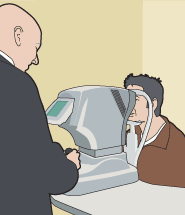
The autorefractor. Computer controlled instrument used to provide an objective measurement of your refractive error or prescription for glasses or contact lenses. This quick, simple and painless test determines the depth and shape of the eyes by measuring how light is changed as it enters the eye.
Using a non-contact tonometer. Using a non-contact tonometer, the optical assistant blows a few puffs of air at each of your eyes in turn. The air rebounds at the instrument, giving a measurement of the pressure inside each eye.
This is an important test, as high pressure can indicate the early stages of glaucoma, a sight-threatening condition.
About your health and lifestyle. The optical assistant will ask questions about your health, your family’s health, your work and your lifestyle.
It is very important to have a clear understanding of your vision needs, especially if a specific problem is the reason for your visit.
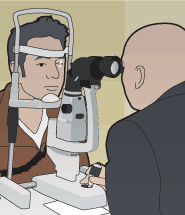
The slit lamp and the use of dilating drops. The patient will then see the doctor and a decision will be made as to whether dilating drops are instilled in their eyes. These dilating drops increases the size of the pupils allowing the doctor to have a through examination of the optic nerve and the retina.
This however, would leave the patient’s vision blurred for some time. Therefore driving or handling of any type machinery is not advised after the test. Usually, patients are informed about this procedure upon the scheduling of appointments. Some patients may not need to be dilated but we would not know whom are these patients.
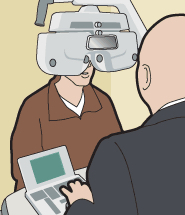
Additionally, an acilliary test which may include Visual Field Test (FDT) may be required. Utilising the latest advancement in glaucoma technology, this simple yet sophisticated test helps detect glaucoma early and accurately. The patient responds to patterns of flickering light in the instrument which calculates information.
Optical Coherence Tomography (OCT) by Heidelberg. This machine is present in all NASA facilities where astronauts are trained and is also in the circling international space station. This machine identifies glaucoma at an extremely early stage, and in some cases even before your doctor can diagnose the symptoms. It also identifies retinal diseases which can lead to poor vision or even blindness.
Corneal topography or pachymetry. This is performed by our Galilei G6 which is completely non-invasive and is the most superior of its machinery in the world.
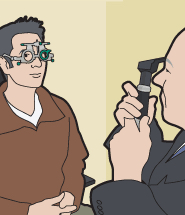
Discussing your needs. The eye specialist will try to answer your queries during the eye examination, and will explain his findings.